


Why Madra Curry Is Served at Every Festival in Himachal Pradesh (And How Locals Make It)
Walk into any wedding, temple feast, or Dussehra gathering in Himachal Pradesh, and you'll smell it before you see it: ghee sizzling with whole spices, curd simmering low and slow, the faint smokiness of an open-fire kitchen. That smell belongs to Madra. Ask any local why this one curry shows up at practically every celebration, and you'll get a story that goes back centuries, not just a recipe.
So why has this dish earned a permanent seat at Himachal's festival table? And how do the people who cook it keep the tradition so exact, generation after generation? Let's dig in.
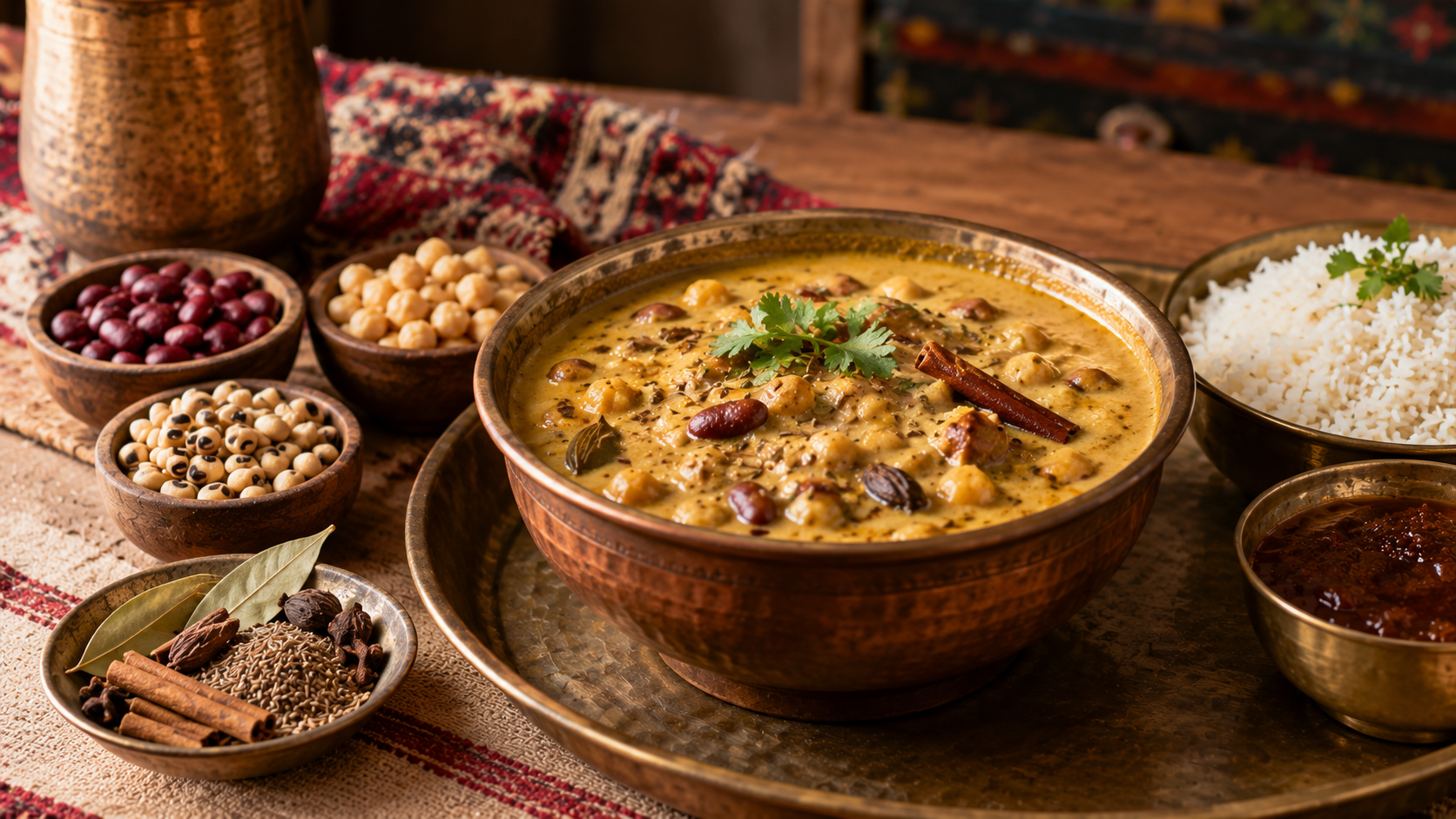
What Exactly Is Madra?
Madra is a slow-cooked curry built on two simple pillars: curd and legumes. Locals typically use rajma (kidney beans), chana (chickpeas), or black-eyed beans, simmered in a thick yogurt gravy loaded with whole spices like cumin, cloves, cinnamon, black cardamom, and asafoetida. No onion, no garlic, sometimes not even tomato or ginger. Doesn't that sound like it should taste bland? It doesn't, and that's exactly the surprise most first-time visitors walk away with.
The dish belongs to a larger feast called Dham, the traditional Himachali festival meal served at weddings, religious functions, and community celebrations. Madra sits right at the centre of that spread, alongside rice, dal, kadhi, and a tangy khatta made from tamarind and jaggery.
Where Does This Tradition Come From?
Here's where the story gets interesting. Local legend traces Dham, and Madra along with it, back over a thousand years, to a Himachali king who fell in love with the Kashmiri Wazwan feast during his travels. He wanted something just as elaborate for his own kingdom, but purely vegetarian. His cooks responded by building an entirely new menu rooted in lentils, dairy, and ceremonial purity. That menu became Dham, and Madra became its signature dish.
Some food historians push the origin even further, linking the dal-and-dairy combination in Dham to Aryan-era eating practices recorded in texts nearly 1,500 years old. Whether you take the king's story or the older Aryan connection as the true origin, one thing stays consistent: Madra was never meant to be an everyday curry. It was built for ceremony.
Why Festivals Specifically?
Ask yourself this: why would a curry this labour-intensive survive only in festival settings and nowhere else on a regular Tuesday? The answer lies in how Dham itself is treated.
Dham isn't just food. It's a ritual. The entire meal is prepared as satvik, meaning it excludes onion, garlic, and other ingredients considered impure in temple cooking traditions. Only a specific community of Brahmin cooks, known as Botis, are permitted to prepare it. These families have often held this role for generations, passing down exact spice ratios and cooking techniques the way you'd pass down a family heirloom.
Because Dham carries this religious and ceremonial weight, Madra by extension becomes tied to sacred occasions rather than daily meals. You won't typically find a home-cooked version served on a random weeknight the way you'd find dal or rice. It shows up when the community gathers, when a wedding needs blessing, when a temple festival calls for offering food to hundreds of guests at once.
There's also a practical layer to this. Making Madra properly takes real time and real skill. The curd has to be cooked at exactly the right pace, or it splits and ruins the entire dish. Multiplying that process to feed two hundred wedding guests requires the kind of experience only professional Boti cooks bring to the table. Doesn't that already explain why Madra stays confined to big occasions rather than casual cooking?
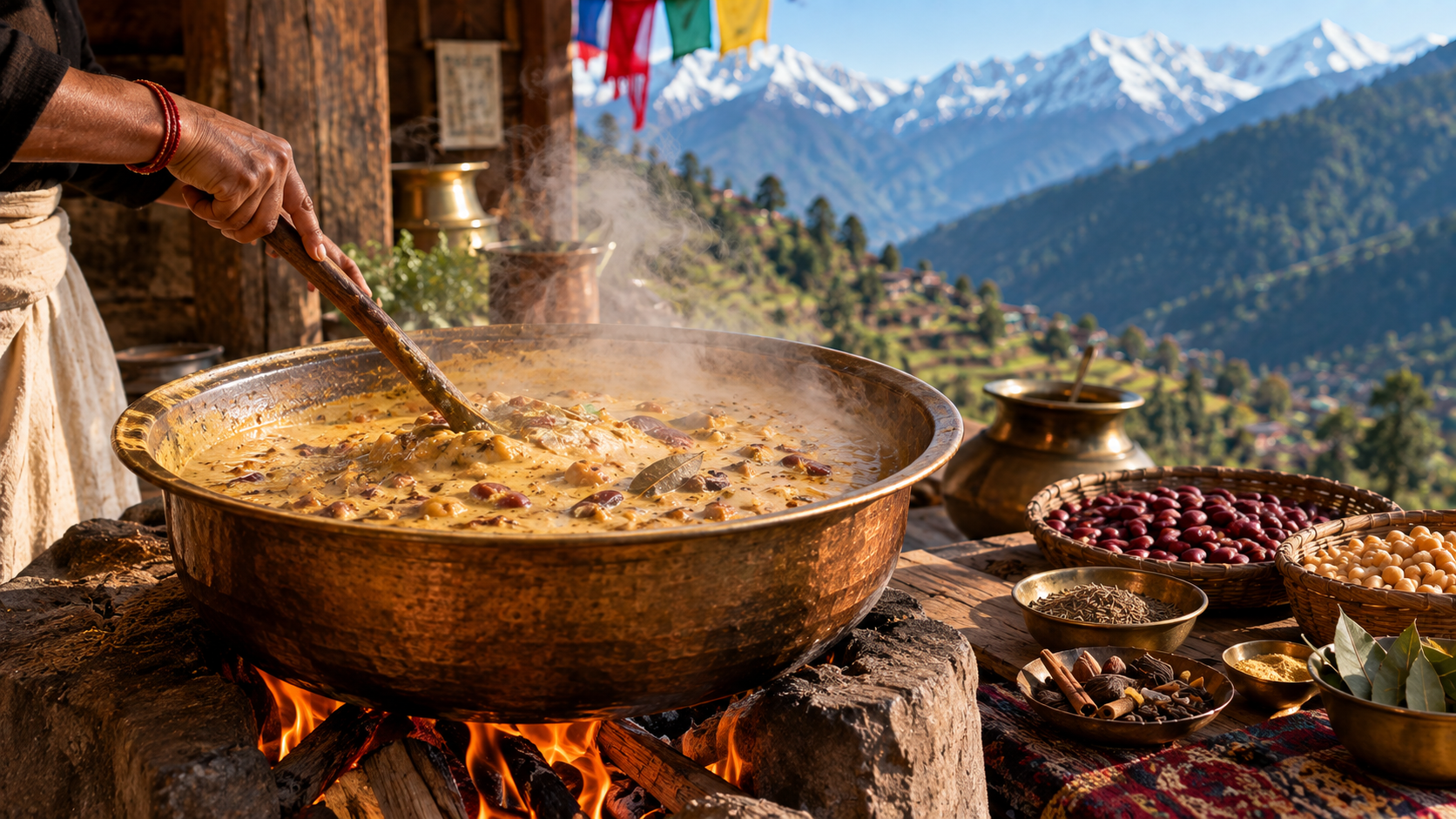
How Locals Actually Prepare It
If you ever get the chance to watch Boti cooks at work, you'll notice how deliberate every step is. The process usually starts the night before a Dham, right through to early morning, all done outdoors over wood fire in large brass or copper vessels called charoti.
Here's the general method locals follow, whether they're cooking for a village wedding or a smaller home version:
Soak and cook the legumes first. Rajma or chana gets soaked overnight, then boiled until tender but never mushy. The beans need to hold their shape once they go into the gravy.
Build the spice base in ghee. Cooks heat generous amounts of desi ghee, then temper it with cumin seeds, cloves, cinnamon, black cardamom, bay leaf, and often asafoetida. Some regional variations add star anise, mace, or nutmeg, depending on the family recipe.
Add curd slowly, never all at once. This is the step that separates a good Madra from a disaster. Full-fat curd gets whisked smooth, then poured in gradually while the cook stirs continuously on low heat. Pour it too fast, or use low-fat curd, and it splits immediately. Some cooks add a spoon of besan (gram flour) to stabilize the curd and prevent curdling.
Simmer low and long. The beans go into the yogurt gravy, and the whole pot simmers on low flame for fifteen to twenty minutes, sometimes longer for large batches, until the gravy thickens into that signature creamy, tangy consistency Madra is known for.
Finish with smoke, if tradition calls for it. In some regions, cooks add a smoky finish called Dhuni: a piece of burning coal gets doused with mustard oil and placed briefly in the pot, then covered to trap the aroma. This step gives the curry its distinct smoky depth, something you simply can't replicate with a regular stovetop method.
Serve on leaf plates with rice. Traditionally, Madra reaches the table on pattal, leaf plates, alongside steamed rice, dal, and khatta, eaten as part of the full Dham spread rather than as a standalone dish.
Regional variations exist too. Chamba is known for its rajma Madra, Kullu leans toward mash dal alongside it, and Mandi has its own take with sepubadi joining the spread. The core technique, though, stays remarkably consistent across the state.
Why This Still Matters Today
You could ask why any of this matters if you're not planning a Himachali wedding. But think about what Madra actually represents: a dish that survived a thousand years without shortcuts, still cooked the same slow way, still tied to the same rituals, still made by the same lineage of families. In a world where most regional recipes get diluted the moment they leave home kitchens, Madra has held its ground.
That's part of what makes tasting it during an actual Himachal trip so different from ordering a version in a city restaurant. The mountain air, the wood-fire kitchens, the copper vessels, none of that travels well onto a takeout menu.
FAQ
1.Is Madra always vegetarian?
Yes, traditional Madra served during Dham is strictly vegetarian and avoids onion and garlic, following satvik cooking principles.
2.What's the difference between rajma Madra and chana Madra?
The base technique stays the same; only the legume changes. Rajma Madra uses kidney beans, while chana Madra uses chickpeas. Some versions also use black-eyed beans or a mix of dals.
3.Can Madra be made outside of a festival setting?
Yes, many Himachali households make a simplified home version for regular meals, though the elaborate wood-fire, brass-vessel method is usually reserved for Dham.
4.Why does the curd split sometimes when making Madra?
Using low-fat curd or adding it too quickly to hot ghee causes splitting. Full-fat curd, added gradually while stirring on low heat, prevents this.
5.Where in Himachal is Madra most associated with?
Chamba is particularly known for its rajma Madra, though the dish appears across the state with regional variations in spice blends and accompanying dishes.
Tasting Madra properly means experiencing it where it was born, cooked over wood fire, high in the Himalayan air, as part of a real Dham feast rather than a restaurant plate. If that kind of authentic Himachal experience is calling you, it starts with choosing where you stay. Book your mountain getaway at Golden Rock or Kanishka and let the local flavours find you.
