


Have you ever seen a lake where mountains seem to float in the sky? High in the remote Himalayas lies a place where this surreal sight becomes real.
Chandratal Lake is a beautiful Himalayan alpine lake located in the vast landscapes of Spiti Valley. Known for its crescent shape and crystal-clear water, the lake sits at an altitude of about 4,300 meters above sea level. What makes it special is its mirror-like surface that reflects the surrounding Himalayan mountains with stunning clarity.
For travelers, photographers, and nature lovers, Chandratal Lake is more than a scenic destination. It is a place where geography, science, and natural beauty come together to create one of the most breathtaking landscapes in the Himalayas. In this guide, you explore what makes Chandratal Lake unique, why it reflects mountains so clearly, and what it feels like to experience this amazing place in person.
Explore the breathtaking beauty of Chandratal Lake, where crystal-clear waters reflect the majestic Himalayas beneath endless mountain skies. Stay at Kanishka, Manali – AM Hotel Kollection and enjoy a peaceful mountain retreat close to Himachal’s most unforgettable landscapes.
What Is Chandratal Lake?
Chandratal Lake is a crescent-shaped Himalayan lake located deep in the high mountain area of Spiti Valley in Himachal Pradesh. Often described as a Spiti Valley high altitude lake, it sits at around 4,300 meters above sea level. Striking mountain landscapes surround the lake and appear almost untouched by modern construction.
The lake belongs to a group of Himalayan glacial lakes formed by ancient glaciers that once covered this region. Over thousands of years, melting glaciers created natural depressions in the terrain. These natural basins slowly filled with glacial meltwater and formed the pure mountain lake ecosystem that exists today. The clear, cold water of Chandratal Lake comes mainly from these glacial origins.
The surrounding area reflects the distinctive cold desert landscape of Himachal. Unlike many other mountain lakes, the land around Chandratal Lake is dry, rough, and striking. Snow-fed streams and glacial meltwater lakes spread across the region. This environment supports mountain vegetation, seasonal birds, and rare wildlife adapted to extreme altitude conditions.
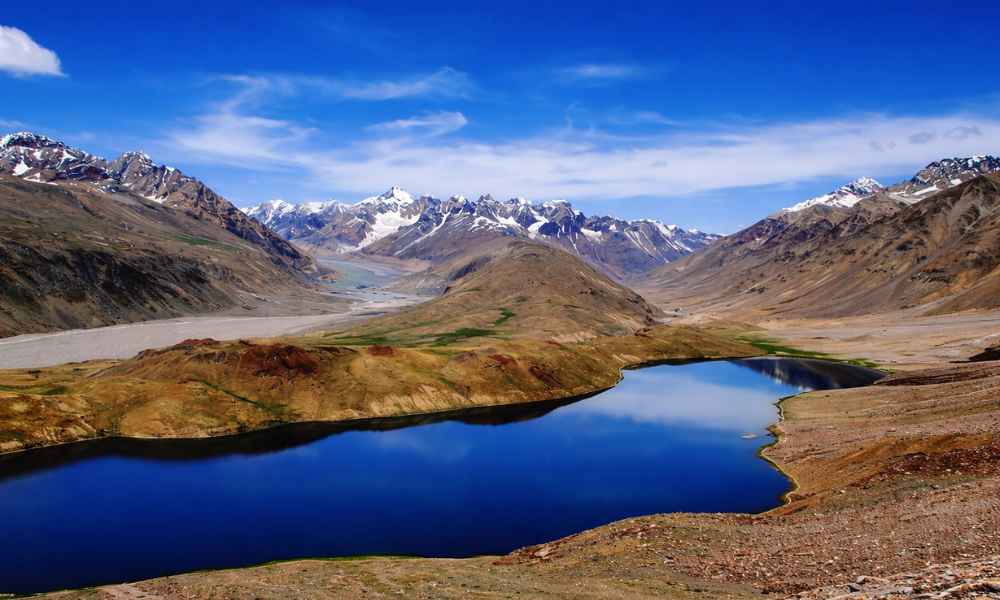
Why Is Chandratal Called the “Moon Lake”?
The name Chandratal comes from two Hindi words: “Chandra,” meaning moon, and “Tal,” meaning lake. From above, the lake forms a shape that closely resembles a crescent moon. Because of this clear crescent-shaped lake form, travelers and locals have long called it the “Moon Lake.”
Chandratal Lake also holds cultural importance in the Himalayan region. Local folklore in Spiti Valley often links the lake to ancient stories and spiritual meaning. In many Himalayan traditions, people believe natural landscapes like high-altitude lakes hold sacred energy and deep spiritual value.
Stories passed down through generations describe Chandratal as a place of peace and heavenly beauty. These legends, whether symbolic or historical, add to the cultural character of the lake and strengthen its connection to the surrounding Spiti cultural geography.
The Science Behind Mountain Reflections in Water
Mirror-like reflections in mountain lakes are not just a visual effect. They happen because of a simple natural reflection process in water.
Light from the surrounding mountains reaches the surface of calm water and reflects back at the same angle at which it arrives. In physics, this rule is called the angle of incidence equaling the angle of reflection. When the water stays perfectly still, it acts like a mirror and creates clear images of whatever stands nearby.
Mirror reflection lakes look especially impressive when several conditions come together. These include smooth water surfaces, clean air, and stable lighting. Under these conditions, the water can reflect mountains, clouds, and the sky with strong clarity.
In high altitude areas like Chandratal Lake, this mountain reflection lake effect becomes even more visible. Low pollution, light winds, and very little disturbance allow the still water to produce sharper and clearer reflections than many other lakes around the world.
Why Chandratal Lake Reflects the Himalayas So Clearly
Several natural conditions explain why Chandratal Lake produces some of the most striking mountain reflections in the Himalayas.
First, the lake sits in one of the cleanest high altitude landscapes in India. Its remote location means very little pollution or human disturbance. The air around the lake stays clear and crisp, which allows sunlight to reach the water surface without interference.
Second, the lake itself is a crystal clear glacial lake fed mainly by melting snow and glaciers. The water carries very little sediment or natural particles, so it stays extremely clear. This clarity improves the quality of reflections.
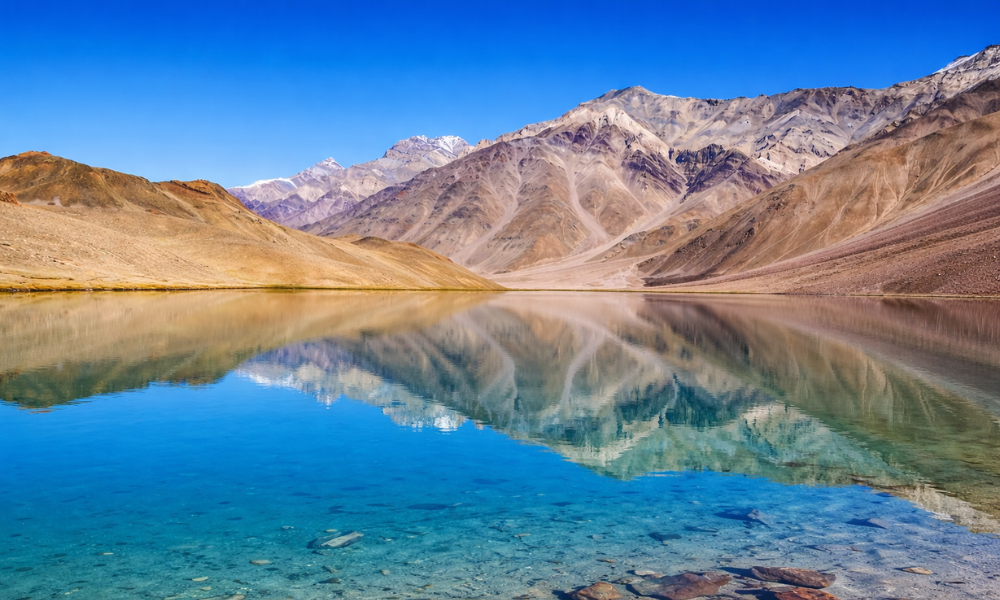
Third, winds in the region often stay calm during the early morning hours. When the water surface remains undisturbed, the entire lake acts like a large natural mirror. At sunrise, many travelers see the surrounding Himalayan peaks reflected clearly across the still water.
These reflection conditions have also made Chandratal Lake one of the most popular locations for Himalayan reflection photography.
The Landscape Around Chandratal Lake
The Spiti Valley landscape around Chandratal Lake looks different from most mountain regions in India. The area does not have dense forests or green valleys. Instead, it has rugged land shaped by glaciers, wind, and extreme temperatures.
The cold desert landscape of Spiti creates wide open views with rocky slopes, golden grasslands, and snow-covered peaks rising in the distance. The deep blue water of the lake contrasts with the pale mountains and makes the scenery stand out.
Seasonal changes bring gentle shifts to the landscape. In summer, patches of alpine flowers appear along the trails that lead to the lake. In autumn, the land turns warm and earthy in color and complements the reflective water.
For photographers and nature lovers, the lake has become one of the most well-known Himalayan nature photography spots. Sunrises and sunsets create beautiful light that makes the mountains and sky appear almost painted across the lake’s surface.
Best Time to Experience the Reflections
The best time to visit Chandratal Lake is between June and September, when the region becomes accessible after the winter snow melts. During this period, travelers can reach the lake through trekking routes or mountain roads that connect the Spiti region.
For those who want to see the famous reflections, early morning offers the best experience. At sunrise, the wind usually stays calm and the water surface remains perfectly still. These conditions allow the surrounding Himalayan peaks to reflect with clear detail.
This period also matches the peak trekking season in the region. Many Himalayan trekking destinations near Spiti Valley include Chandratal Lake as a highlight because of its accessibility and scenic beauty.
Travelers who arrive early often witness one of the most memorable sights in the Himalayas. The rising sun slowly lights the mountains while their reflections glow softly in the lake below.
Experiencing Chandratal Lake: A Himalayan Travel Moment
Standing beside Chandratal Lake feels almost unreal. The silence of the high altitude surroundings creates a sense of calm that is rarely found in crowded tourist places.
As a high altitude trekking lake in India, Chandratal offers visitors a landscape that feels untouched and wide. The surrounding mountains rise above the lake while the sky stretches across the horizon.
At sunrise, the water becomes perfectly still. The mountains reflect across the lake’s surface and form a symmetrical image that blurs the line between sky and land. Many travelers describe this moment as one of the most peaceful experiences in the Himalayas.
For photographers, trekkers, and travelers, the lake is not just a destination. It becomes a moment that stays in your memory long after the journey ends. These rare experiences make Chandratal Lake one of the most remarkable Himalayan photography destinations.
Explore more unique Himalayan destinations through curated travel insights from AM Hotel Kollection.
FAQs
What is Chandratal Lake and why is it famous?
Chandratal Lake is a high-altitude glacial lake located in Spiti Valley. It is famous for its crescent shape and mirror-like water that reflects the surrounding Himalayan mountains.
Where is Chandratal Lake located?
Chandratal Lake is located in the remote Spiti Valley region of Himachal Pradesh. The lake sits at a high altitude within the Himalayan mountain range.
What is the altitude of Chandratal Lake?
The altitude of Chandratal Lake is approximately 4,300 meters above sea level. This high elevation contributes to its clear atmosphere and dramatic mountain surroundings.
Why does the lake reflect mountains so clearly?
Chandratal Lake reflects mountains clearly because of its extremely clean water, calm surface conditions, and low atmospheric pollution. These factors allow light to reflect off the surface like a natural mirror.
Is Chandratal Lake safe for travelers?
Yes, Chandratal Lake is generally safe for travelers during the summer season when access routes are open. However, visitors should be prepared for high-altitude conditions and sudden weather changes.
Conclusion: Where Mountains Meet the Sky
Chandratal Lake is more than a scenic lake hidden in the Himalayas. It is a place where natural science, geography, and stunning beauty come together in one landscape.
From its glacial origins and crescent moon shape to the clear reflections of the surrounding mountains, the lake represents one of the most unique environments in the Himalayan region. For travelers looking for remarkable destinations, Chandratal offers a rare moment where mountains, sky, and water appear to merge into one unforgettable view.
In the quiet stillness of Spiti Valley, Chandratal Lake reminds visitors that some of the most special experiences in nature are also the simplest. A calm lake, a clear sky, and mountains reflected perfectly across the water.
Plan your stay near Spiti Valley and experience the raw beauty of Chandratal Lake with clear night skies, peaceful surroundings, and a journey that truly connects you to the Himalayas. Book your stay at Kanishka, Manali – AM Hotel Kollection and make your mountain escape more meaningful.
